
Visual working memory guide
Memory Sequence Games: Why Glow Grid Gets Hard
Glow Grid begins with three lights on a fixed board. By a flawless seventh round, the sequence must be recalled backwards. That jump reveals what makes a memory sequence game interesting: the challenge is not seeing the lights, but preserving both their locations and their order.
What is a memory sequence game?
A memory sequence game shows locations or objects one at a time, hides the pattern, and asks the player to reproduce the same order. The task combines spatial recall with serial order: remembering the right cells is not enough when tapping them in the wrong order still fails the round.
This format resembles the computerized Corsi block-tapping task. In that task, squares light sequentially before the participant clicks them in the same order.
Glow Grid uses the same watch-then-recall loop as game material. However, it adds banked scoring, adaptive span, lives, and changing direction rules.
How does Glow Grid build a sequence?
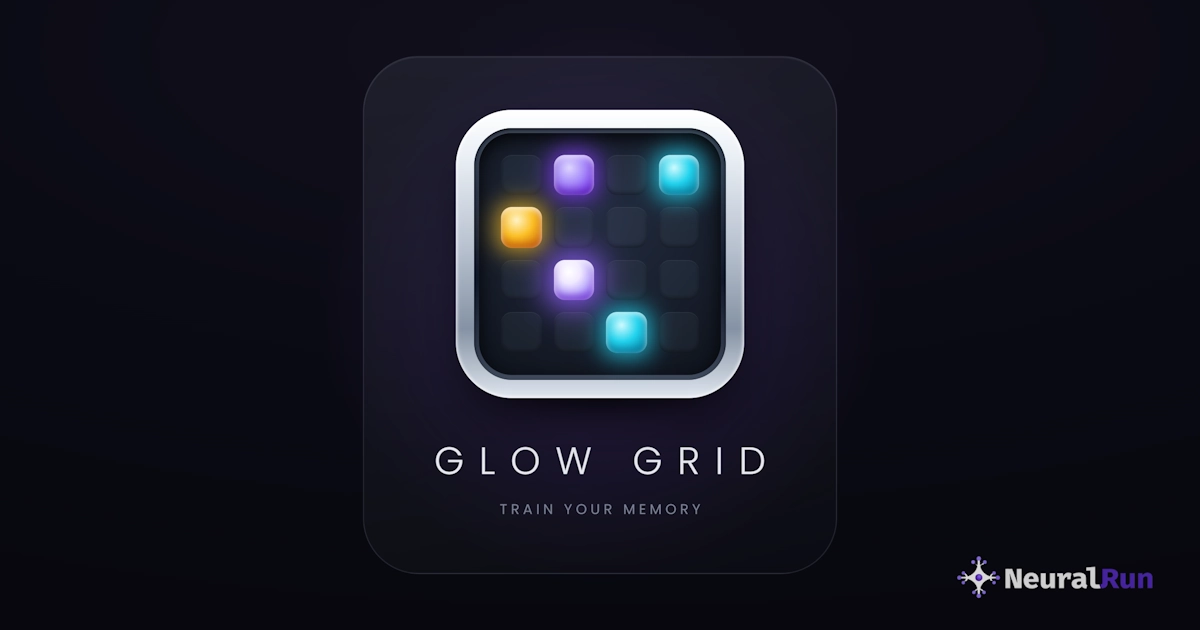
Glow Grid uses a fixed 4×4 board containing 16 cells. Every round selects distinct cells, lights them one by one, then asks for the sequence from memory. A round starts at span three, rises after two consecutive clears, falls after a miss, and never exceeds nine cells.
No cell repeats within one round. Therefore, a double-tap is always an error rather than an ambiguous instruction.
The board also stays fixed. Difficulty comes from the sequence and rule, not a moving layout that forces the player to relearn the interface.
Glow Grid's live rule constants:
- Board: 4×4, with 16 fixed positions.
- Span: starts at 3, increases after every second clear, and caps at 9.
- Failure: one wrong tap or timeout loses a life and pays no points.
- Recall timer: 1,200 ms plus 600 ms per cell, from 3 seconds at span 3 to 6.6 seconds at span 9.
- Run safety: three lost rounds end the run.
Why does reverse recall change the task?
Forward recall lets the first remembered location become the first action. Reverse recall delays that location until last and requires the whole sequence to be reordered before tapping. The same cells remain relevant, but the player must manipulate their order instead of only replaying it.
Research examines forward and reversed Corsi recall as separate conditions. One study of working-memory components in the Corsi task tested both orders alongside competing tasks.
Glow Grid introduces backward recall at 30 banked points. A flawless run reaches that boundary after round seven.
At 80 points, reached after flawless round fourteen, the direction starts switching. A persistent chip always says FORWARD → or BACKWARD ←.
Why does Glow Grid bank points only after a full clear?
Glow Grid holds each correct tap as a pending point until the full sequence is complete. Clearing the round banks every point. A wrong tap or timeout erases the pending total. This makes the score represent sequences actually recalled, rather than partial progress collected from failed rounds.
The rule also creates a clean decision boundary. A nine-cell sequence is worth nine points only after all nine locations are returned in the required order.
For the same reason, phase changes happen between rounds. The direction never flips underneath a player who is halfway through a recall.
How does the 40-round Daily work?
Glow Grid Daily contains 40 completed rounds or ends sooner when all three lives are lost. Every player receives the same date-seeded sequences, while a HUD counter shows progress. Endless mode removes the round limit and keeps the familiar survive-as-long-as-you-can structure.
A Daily round counts when it clears, fails, times out, or is voided after a tab switch. Backgrounding cannot create extra rounds.
The fixed length makes attempts comparable. Everyone receives the same maximum number of scoring opportunities, instead of ranking by who had the most free time.
How should you approach a longer light sequence?
Watch the route instead of naming isolated squares. Group nearby cells into short spatial chunks, keep your eyes near the board's center, and confirm the direction chip before recall begins. When the rule changes, rehearse the sequence in the required direction before making the first tap.
- Trace a path. Read the sequence as movement across the board.
- Group positions. Hold two or three short chunks instead of nine unrelated cells.
- Check the chip. Confirm forward or backward before the first tap.
- Protect the clear. Partial points disappear, so guessing the final cell has no scoring advantage.
For a different kind of cognitive warm-up, compare Glow Grid with NeuralRun's guide to reaction time and restraint games or rapid number sense games.
Do memory sequence games improve memory?
Practice can improve performance on the memory sequence task being played. Evidence for broad transfer to unrelated memory skills is less certain. Treat Glow Grid as entertainment and focused visuospatial practice, not medical treatment, diagnosis, or proof that general memory has improved.
The narrow claim is the useful one: playing rehearses encoding, holding, and returning a short spatial sequence under a time limit.
Glow Grid produces a task score, accuracy, and deepest span. Those measures describe the run, not a person's overall cognitive ability.
Memory sequence games FAQ
What is a memory sequence game?
A memory sequence game shows locations or objects one at a time, hides the sequence, and asks the player to reproduce the same order. It tests whether the player can encode where each cue appeared, preserve its order, and retrieve the sequence moments later.
How many cells are in Glow Grid?
Glow Grid uses a fixed 4×4 board with 16 cells. A sequence starts at three distinct cells and can grow to nine. Cells never repeat within one sequence, so every required tap points to a different location.
When does Glow Grid switch to reverse order?
Glow Grid switches to backward recall after the player banks 30 points, which happens after round seven in a flawless run. At 80 points, reached after round fourteen in a flawless run, the required direction begins switching between forward and backward.
Do memory sequence games improve memory?
Practice can improve performance on the sequence task being played. Evidence for broad transfer to unrelated memory skills is less certain. Glow Grid should be treated as entertainment and focused visuospatial practice, not medical treatment or proof of general memory improvement.